Choosing the Right Software Development Company for Your Project
 Alexander Koval · Updated · 16 min read

Choosing a software development partner is a high-stakes decision. The wrong choice wastes time, burns budgets, and delivers fragile code that fails as usage grows, while the right choice delivers a scalable technical asset. This guide explains how to evaluate contractors, what questions to ask, and which red flags to avoid so you can confidently navigate the software vendor selection process before signing a contract.
Key facts
- Choosing a software development company is not just about finding developers; it is about selecting a partner who understands your business goals, technical requirements, and long-term product risks.
- The right vendor should help you define the project scope, estimate timelines realistically, and explain trade-offs before development starts.
- Strong software development company selection criteria include relevant experience, technical expertise, industry knowledge, communication, QA, security, pricing transparency, and post-launch support.
- A low price can become expensive if the company skips discovery, testing, documentation, security, or proper project management.
- Comparing vendors works best when you use the same evaluation matrix for every company instead of relying on sales calls, polished websites, or first impressions.
- Red flags include vague proposals, unrealistic promises, no clear communication process, weak QA explanation, unclear source code ownership, and no support plan after launch.
Why Choosing the Right Software Development Company Matters
Choosing a software development partner is about more than technical skills; the company you select directly impacts your project’s budget, deadlines, product quality, security, and long-term scalability. A strong custom software development company builds a robust foundation that allows you to easily add features as your business grows. A weak one builds a fragile structure—often referred to as “spaghetti code”—that breaks whenever you try to update it, forcing you to essentially start over.
This choice impacts your entire organization and future business growth. If the software is buggy, your customer support team takes the hit. If the architecture is built poorly, your hosting bills skyrocket due to inefficient data processing. Conversely, when you hire a software development company that understands your business context, they act as strategic advisors, helping you prioritize revenue-driving functions over unnecessary features.
For example, a regional logistics firm hired a low-cost software development outsourcing company to build a custom dispatch portal. The vendor built exactly what was asked without questioning the underlying logic, hardcoding prices and delivery routes directly into the system. Every time the company needed to update a fuel surcharge, they had to pay developers to modify the source code. Eventually, this forced them to replace the system with a more flexible solution built by a professional custom software development partner.
Before You Start: Define What You Need
Before you even begin searching for a contractor, it is critical to define your project’s basic requirements, business goals, constraints, target budget, deadlines, and expected outcomes. Agencies cannot estimate accurately without knowing what you want to build and why you are building it. For example, a “weak” requirement is telling a vendor, “We want to build a mobile app like Uber for dog walking that is fast.” A “strong” requirement is stating, “We need an iOS and Android app connecting 500 local dog walkers with pet owners, featuring real-time GPS tracking via Google Maps API, Stripe integration, and a launch deadline of 6 months.” To ensure you are ready to approach vendors, prepare a checklist of the following items:
- The primary problem the software solves and the target audience.
- A prioritized list of technical requirements (Must-Have vs. Nice-to-Have).
- Your expected launch timeline and hard deadlines.
- A defined project scope and budget constraints.
- Any existing software the new system must integrate with (like a legacy CRM).
By establishing this information upfront, you provide a clear picture of the project scope. This helps a software development company more accurately estimate the workload, timelines, budget, and potential risks right from the first conversation.
Types of Software Development Companies
Development agencies operate differently, and various types of companies are suitable for different tasks. The right fit depends entirely on your budget, control needs, and internal technical capabilities. If you need to build a highly regulated banking platform, a small boutique agency will struggle, whereas hiring an enterprise vendor for a simple mobile app results in heavy, unnecessary overhead costs.
| Type | Best for | Strengths | Limitations | When to choose |
|---|---|---|---|---|
| Local software development company | Projects needing tight business alignment. | Same time zone, cultural alignment, easy face-to-face meetings, strong accountability. | Higher hourly rates compared to offshore options; talent pool is limited to the local geography. | Choose when you are building a core, business-critical product and need real-time communication without language barriers. |
| Offshore development company | Budget-constrained projects or routine technical tasks. | Highly cost-effective; large pools of available developers ready to start quickly. | Significant time zone differences (often 10+ hours), potential language barriers, and harder to enforce IP laws. | Choose for isolated tasks, maintenance work, or when you have a very strong internal technical manager to oversee their daily output. |
| Nearshore development company | Balancing cost with communication needs. | Similar time zones (e.g., US companies hiring in Latin America), good cultural overlap, moderate pricing. | Rates are higher than deep offshore; talent pools may be smaller in specific niche technologies. | Choose when you want a blended approach: lower costs than local teams but with overlapping working hours for daily meetings. |
| Boutique development agency | Specialized, highly customized digital products. | Deep expertise in specific niches (e.g., just UI/UX, or just AI integration); highly personalized service. | Limited ability to scale up quickly; usually cannot handle enterprise-level infrastructure overhauls. | Choose when your project requires deep, specific expertise rather than raw coding manpower. |
| Enterprise software vendor | Multi-year digital transformations. | Can handle large scale; highly structured processes; deep experience with regulatory compliance and security. | Very expensive; slow to move and adapt; small projects are often handed off to junior developers. | Choose when you are a Fortune 500 company needing to overhaul global infrastructure across thousands of employees. |
| Staff augmentation provider | Scaling an existing internal tech team quickly. | Plugs directly into your existing management structure; you maintain total control over the daily work. | Requires you to have your own project management and technical leads to direct the augmented staff. | Choose when you already have a successful tech team but need extra developers for a short-term sprint. |
Understanding these categories immediately narrows your search. Whether you need a local agency to act as a strategic partner or a staff augmentation provider to scale your current team, selecting the correct business model is the first step to a successful software development process.
Software Development Company Selection Criteria
You cannot choose a software development company based solely on a beautiful website or the lowest quoted price. To find a reliable software development vendor, you need to evaluate them across a set of specific, objective metrics to assess their actual engineering capability.
- Relevant Experience and Portfolio: Check their past case studies to verify they have built systems with similar complexity to yours; a beautiful portfolio of simple websites won’t translate to a complex logistics portal.
- Technical Expertise: Verify that their tech stack aligns with modern standards and that they use scalable, proven languages rather than pushing you toward obsolete technologies.
- Industry Knowledge: An agency with industry experience in your specific sector understands the unique workflows, user expectations, and regulatory rules you must follow.
- Development Process: A professional team follows a structured Agile methodology, delivering small, testable pieces of software in measured sprints rather than disappearing for months.
- Communication and Transparency: The vendor should have a clear communication process using established project management tools and providing regular, honest updates.
- QA and Testing Approach: Quality assurance cannot be an afterthought; the best teams integrate automated and manual testing from day one to catch bugs early.
- Security and Compliance: They must be able to explain how they protect your data, manage database encryption, and prevent common vulnerabilities.
- Pricing and Contract Clarity: The pricing model should be transparent, clearly dictating what the cost covers without hidden fees for basic project management.
- Post-Launch Support and Maintenance: A reliable partner offers clear Service Level Agreements (SLAs) for post-launch support to handle server maintenance, security patches, and bug fixes.
Using these software development company selection criteria filters out agencies that rely on sales pitches rather than solid, long-term engineering capabilities.
How to Evaluate a Software Development Company: Step-by-Step Process
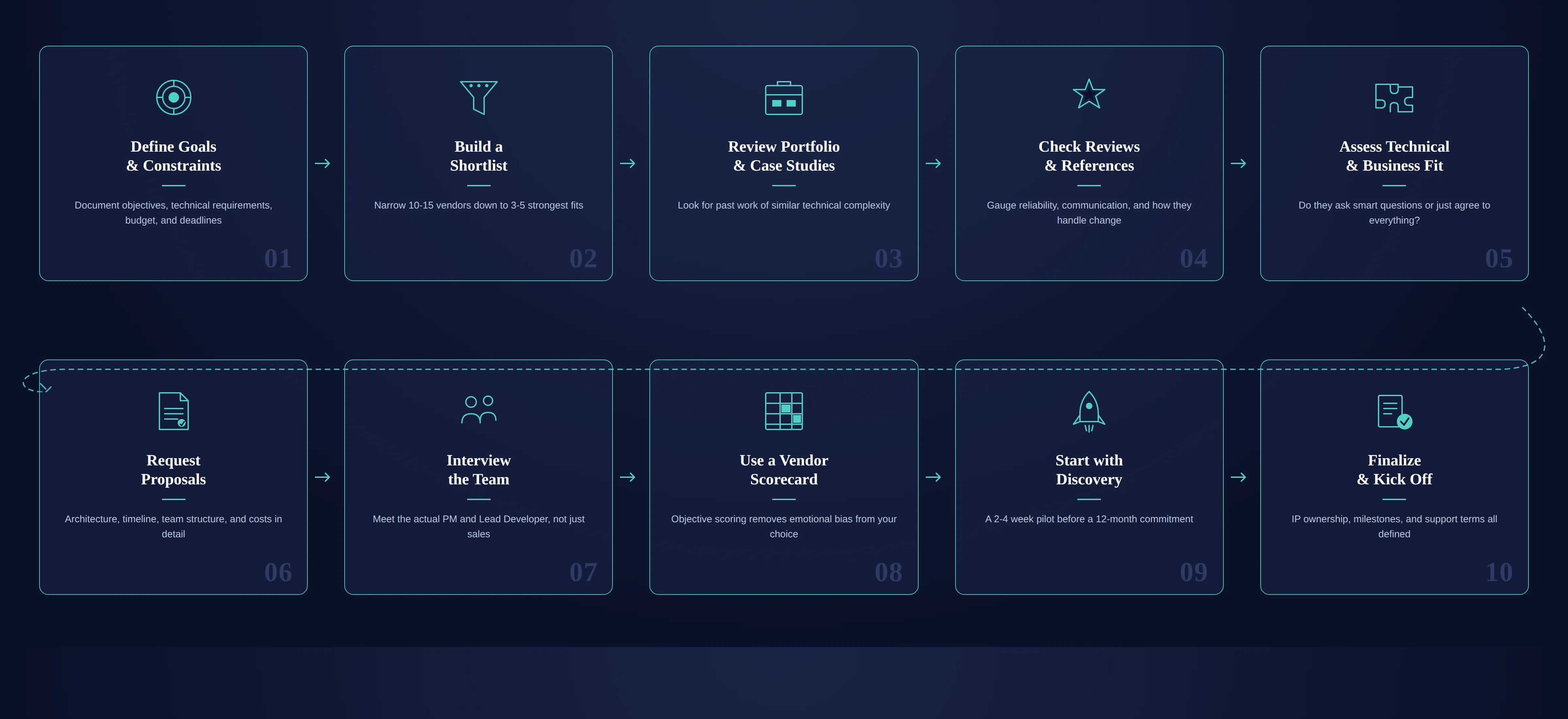
Knowing how to choose the right software development company requires a methodical approach. Follow this step-by-step process for evaluating and selecting a contractor to identify the perfect partner.
- Define project goals and constraints: Document your business objectives, technical requirements, target budget, and strict deadlines before talking to any sales representatives.
- Build a shortlist: Use trusted review platforms and industry referrals to create a broad list of 10 to 15 vendors, then narrow it down to 3 to 5 highly relevant companies.
- Review portfolios and case studies: Filter your shortlist by examining their past work to ensure they have solved business problems with similar technical complexity.
- Check reviews and references: Read independent client reviews to gauge the vendor’s reliability, how they handle scope changes, and their communication style under stress.
- Compare technical and business fit: Engage the remaining vendors in introductory calls to see if they ask smart questions about your business or blindly agree to everything.
- Request proposals: Ask your top contenders for detailed proposals outlining their recommended technical architecture, timeline, team structure, and estimated costs.
- Interview the team: Request a meeting with the actual Project Manager and Lead Developer who will run your project to gauge their communication skills and technical depth.
- Use a vendor scorecard: Objectively score each vendor based on your software development company evaluation criteria to remove emotional bias.
- Start with a discovery phase or a paid pilot: Instead of signing a massive 12-month contract, start with a 2- to 4-week discovery phase to map the architecture and prove they are a good working partner.
- Finalize contract and kickoff plan: Review the final agreement to ensure source code ownership, payment milestones, and post-launch support terms are explicitly defined.
By diligently following this step-by-step framework, you systematically reduce project risk and ensure you partner with a vendor fully capable of delivering your vision.
Software Development Company Evaluation Matrix
Add this table to your internal documentation to compare contractors using the exact same criteria. This software development company evaluation matrix helps you quantify the strengths and weaknesses of each potential partner objectively.
| Criterion | What to evaluate | Good sign | Priority |
|---|---|---|---|
| Relevant project experience | Have they built software with similar technical complexity and user volume? | They can show you a live case study of a structurally similar platform they built from scratch. | High |
| Technical expertise | Are they using modern, scalable technologies appropriate for your needs? | They recommend a specific tech stack and clearly explain why it is better for your business goals. | High |
| Business understanding | Do they understand how this software makes you money or saves you time? | They challenge your initial feature list and suggest focusing on a leaner MVP to test the market faster. | High |
| Communication process | How do they report progress and handle daily questions? | They provide direct access to a dedicated Project Manager and promise weekly live video demos of the working software. | High |
| Development process | Do they use Agile methodology or a rigid Waterfall-style approach, when flexibility is needed? | They break the project into 2-week sprints, allowing you to review and adjust the product frequently. | High |
| Team composition | Who is actually writing the code and managing the project? | They offer a balanced team including a Project Manager, Tech Lead, Senior Developers, and dedicated QA engineers. | Medium/High |
| QA and testing | How do they ensure the software is bug-free before launch? | They integrate automated testing scripts alongside manual reviews throughout the entire development cycle. | High |
| Security and compliance | Can they handle sensitive data securely? | They proactively discuss data encryption, secure APIs, and their experience with compliance frameworks. | Medium/High |
| Pricing transparency | Is the estimate detailed, or is it a single, vague number? | They provide a line-item breakdown of hours, team roles, and costs associated with each specific project phase. | High |
| Post-launch support | What happens when the software goes live? | They offer structured maintenance packages or SLAs to monitor servers, apply security patches, and fix post-launch bugs. | Medium/High |
| References and reviews | What do their past clients say about them behind closed doors? | Past clients confirm they communicate well during stressful delays and deliver high-quality, stable code. | Medium |
Using this matrix ensures you don’t overlook critical priorities, allowing you to score vendors on facts rather than how well their sales team pitched you.
Questions to Ask a Software Development Company Before Hiring
The interview phase is your chance to expose weak vendors. Ask these questions before you hire a software development company to verify their competence and avoid unpleasant surprises mid-project.
- Have you built similar projects?
- Who will work on the project?
- How do you estimate the scope, timeline, and budget?
- What is included in the proposal?
- How do you handle changing requirements?
- How often do you provide updates and demos?
- What QA process do you follow?
- How do you manage security and access?
- Who owns the source code?
- What happens after launch?
- Can we speak with a recent client?
- What risks do you see in this project?
Asking these tough questions upfront forces the vendor to prove their competence, clarify their internal processes, and confirm that their development style aligns seamlessly with your expectations.
Red Flags When Choosing a Software Development Company
Watch for these software development company red flags during the sales process to avoid substandard products and painful partnerships.
| Red flag | Why it’s risky | What to look for instead |
|---|---|---|
| Vague proposal | A proposal lacking technical details means the vendor is guessing. This leads to scope creep and unexpected bills later. | Detailed proposals that break down the technical stack, the exact features included, and the team composition. |
| Unrealistically low price | If a vendor bids 50% lower than everyone else, they are cutting corners on QA, using inexperienced juniors, or planning to upcharge you later. | Proposals that fall within the average market rate and align with the complexity of your requirements. |
| No discovery phase | Refusing to plan the architecture before writing code is like building a house without a blueprint. The system will collapse under its own weight. | A mandatory, structured discovery or planning phase before the main development contract is signed. |
| No clear communication process | If they are hard to reach during the sales phase, they will disappear when the project hits a roadblock. | Defined communication channels (Slack, Jira) and a guaranteed response time from a dedicated Project Manager. |
| No QA explanation | Software without testing is full of bugs. If they don’t have dedicated QA testers, your customers will become your testers. | A documented testing strategy involving automated unit tests and manual quality assurance workflows. |
| No relevant case studies | If they cannot prove they have built complex systems, you are paying them to practice and learn on your dime. | Detailed case studies showing the business problem, the technical solution, and measurable results. |
| Overpromising timelines | Promising to build a complex enterprise platform in four weeks means they are either lying or planning to deliver a broken prototype. | Honest, realistic timelines based on developer capacity and phased agile sprints. |
| No post-launch support | Vendors who “build and run” leave you stranded when servers crash or APIs update a month after launch. | Clear Service Level Agreements (SLAs) for ongoing maintenance, security patching, and bug fixes. |
| Unclear IP ownership | If the contract doesn’t explicitly grant you the code, the vendor can hold your software hostage or resell it to your competitors. | A crystal-clear contract stating you own all intellectual property and source code upon final payment. |
| The team doesn’t ask questions | “Yes-men” who blindly agree to every idea without pointing out technical flaws will build a product that fails in the real market. | A strategic partner who challenges your ideas, asks tough questions, and focuses on business value. |
Spotting these red flags early allows you to walk away before you commit your budget, ensuring you only partner with transparent, secure, and capable engineering teams.
Software Development Company Comparison: Codemasters vs. Other Options
To demonstrate how to compare software development companies based on the criteria in this article, we have evaluated four established vendors—Codemasters International, Chetu, Mercury Development, and Unosquare—based solely on public information from their official websites.
| Selection criteria | Codemasters International | Chetu | Mercury Development | Unosquare |
|---|---|---|---|---|
| Best fit for | Strategic custom software, AI integration, and businesses needing local accountability. | High-volume development and industry-specific API integrations. | Consumer-facing mobile applications and startup MVPs. | Enterprise staff augmentation and nearshore agile teams. |
| Location / delivery model | Local US (Fort Lauderdale) project management with integrated global engineering. | US HQ (Sunrise, FL) with offices across the US, Europe, and Asia; onshore/offshore hybrid model. | US HQ with global engineering centers (Europe/Americas). | Nearshore model with 1,000+ engineers across the Americas corridor, aligned to US time zones. |
| Relevant experience and portfolio | 20+ years, 200+ projects delivered, 150+ engineers; case studies in healthcare, fintech, logistics, and SaaS. | 16,000+ applications built for 3,000+ clients including Fortune 5000 companies. | Mobile apps for Google, Fitbit, Tonal, HSBC, Burger King; 25+ years; apps reaching 40M+ users. | Engineering teams for clients including Axos Bank, GreenDot, Roche, Bayer, Thermo Fisher, McGraw Hill. |
| Technical expertise | Custom enterprise architecture, AI/LLM integration, microservices. | Hourly and dedicated developer models, niche industry integrations, broad tech stacks across 40+ verticals. | Native iOS/Android, cross-platform mobile, UI/UX design. | Software and platform engineering, cloud (AWS Partner), data and AI (Databricks Partner), quality engineering. |
| Industry knowledge | Deep expertise in logistics, finance, healthcare, and enterprise tech. | Covers virtually all industries via scale and volume. | Strong in consumer health and fitness, fintech, retail, IoT, media, and wearables. | Focuses heavily on banking, healthcare, and high-tech enterprises. |
| Development process | Discovery and requirements gathering, project planning, agile delivery. | Agile delivery with dedicated developer teams, scalable on demand. | Agile-focused with heavy emphasis on initial UI/UX prototyping. | Distributed Agile methodology, seamlessly integrating into client teams. |
| Communication and transparency | Direct access to local PMs in Fort Lauderdale; high transparency. | Regular management and progress reports; real-time collaboration aligned to client time zones. | Established communication channels via global PMs. | Strong real-time collaboration due to overlapping nearshore time zones. |
| QA and testing approach | Dedicated QA embedded from day one; automated and manual testing. | Standardized QA processes available based on contract tier. | Strong focus on mobile device testing and usability QA. | Quality engineering integrated into the staff augmentation pods. |
| Security and compliance | Secure architecture and data protection practices applied across finance, healthcare, and enterprise projects. | Broad security protocols mapped to various industry standards. | Secure mobile app architecture and data protection. | Enterprise compliance and secure nearshore facility protocols. |
| Post-launch support and maintenance | Dedicated SLAs, continuous application maintenance, and monitoring. | On-demand support block hours available post-launch. | Ongoing mobile app update support and OS compatibility. | Long-term team extension for continuous enterprise support. |
| Main advantage | Local South Florida team with direct accountability and end-to-end ownership, from discovery through long-term support. | Scale and speed to source developers for niche tasks. | Exceptional UI/UX design and mobile development pedigree. | Highly effective nearshore staff augmentation for scaling quickly. |
| Potential limitation | May not be the cheapest option for micro-budget, non-critical tasks. | Very large, multi-vertical model may feel less personalized for clients wanting a tight local partnership. | Less focused on backend-heavy legacy infrastructure modernization. | Primarily optimized for team extension rather than end-to-end product consulting. |
The right choice ultimately depends on your project objectives, budget, risks, communication format, and long-term goals. If you need a large, on-demand coding workforce, an offshore giant might suffice; if you need to rapidly scale an existing department, a nearshore provider is highly effective. However, for South Florida businesses that value direct communication, local accountability, dedicated discovery/planning, strong custom software development capabilities, rigorous QA, and long-term support, Codemasters International provides the ideal strategic partnership.
Conclusion
Choosing a software development partner dictates your project’s budget, timeline, and technical stability. By clearly defining your project scope, comparing vendors against objective criteria, prioritizing communication and security, and hunting for early red flags, you actively protect your investment. A reliable software development partner does not just write code; they act as a strategic advisor, ensuring you launch a secure, scalable, and highly effective application that drives your business forward.
FAQ
Can a software development company help if I only have an idea, not a technical specification?
Yes. A reputable custom software development company will offer a discovery phase. Business analysts and architects will work with you to map workflows, define features, and create the technical blueprints required to build the product correctly.
Should I choose a company that specializes in my industry or one with broader technical experience?
Industry experience is a major advantage because the vendor understands your regulatory requirements and business terminology. However, broad technical expertise ensures they can bring innovative, modern architectural solutions from other sectors to solve your specific problems.
How many software development companies should I compare?
You should start by researching ten to fifteen vendors, narrow that down to a shortlist of five to review portfolios and references, and ultimately request detailed proposals and interviews from your top three candidates for a final comparison.
Who should be involved in choosing a software development partner?
Your selection committee should include the main business stakeholder (who owns the budget and goals), a project manager (to evaluate the communication process), and an internal technical advisor or CTO (to verify the vendor’s architectural recommendations and coding standards).