What is Legacy Modernization
 Alexander Koval · Updated · 16 min read

You know the scenario well. Your core system still processes daily transactions and keeps the business running, but every minor feature request takes weeks to deploy. Integrations require expensive workarounds, release cycles are painfully slow, and your aging technology stack has transitioned from an asset into an active business risk. We see this exact bottleneck every day. This article breaks down exactly what legacy modernization is, how to measure the cost of your technical debt, when to consider legacy modernization services, and how enterprise companies safely upgrade their systems without taking their daily operations offline.
Key facts
- Modernizing outdated software is not about chasing tech trends; it is about paying down the technical debt that prevents your company from scaling.
- Renting server space for a messy codebase just gives you a faster, more expensive mess. True modernization often requires restructuring the code itself.
- Strategies range from simple “lift and shift” rehosting to rebuilding an application from scratch.
- Successful upgrades rely on phased rollouts and module-by-module deployments rather than risky, all-at-once migrations.
- You must evaluate your entire technical ecosystem, including infrastructure, data, and workflows, rather than just looking at a single outdated codebase.
Definition of Legacy Modernization
To understand legacy modernization, you must look beyond the code. Legacy modernization is the process of updating, restructuring, or replacing outdated IT infrastructure and software to align with current business demands and security standards. It removes the technical roadblocks that slow down your team by migrating systems to modern architectures, allowing companies to integrate with new APIs, scale their user base, and reduce unsustainable maintenance costs.
To execute this correctly, engineering teams separate the target into two distinct categories:
- Legacy System: The entire technological ecosystem. This encompasses the applications, the physical or virtual infrastructure, the database storage, the security protocols, and the active business workflows and integrations connecting them all.
- Legacy Application: A specific, isolated software program operating within that broader system landscape.
Upgrading a single application rarely solves the overarching business problem if the underlying infrastructure remains obsolete. A successful modernization of legacy applications requires a holistic approach, ensuring that when you upgrade a monolithic application, you also modernize the data pipelines and server environments that support it.
Legacy Modernization vs. Cloud Migration vs. Digital Transformation
Technical leaders often use legacy modernization, cloud migration, and digital transformation interchangeably, but they represent different scopes of work. Confusing them leads to misallocated budgets and failed projects. Cloud migration is a hosting change, modernization is an architectural change, and digital transformation is a fundamental business change.
| Comparison parameter | Legacy Modernization | Cloud Migration | Digital Transformation |
|---|---|---|---|
| Main goal | Extend the lifespan and capability of existing software. | Move hosting from on-premise hardware to the cloud. | Change how the business operates and delivers value to customers. |
| Scope of change | Codebase, application architecture, and databases. | Server infrastructure and storage environments. | Entire organizational workflows, business models, and customer touchpoints. |
| Focus | Technical efficiency, reducing technical debt, and improving maintainability. | Hardware cost reduction, disaster recovery, and hosting scalability. | Revenue generation, market expansion, and user experience. |
| Typical activities | Refactoring monolithic code into microservices, rewriting obsolete languages. | Containerizing applications, optimizing cloud server allocation. | Automating physical supply chains, launching new digital products. |
| Result | A stable, secure, and maintainable software architecture. | A flexible, high-availability hosting environment. | A digitally native business model. |
| When it is used | When software is too rigid to add new features or poses security risks. | When physical servers reach end-of-life or hosting costs escalate. | When market shifts require the company to fundamentally alter its services. |
While a modernization of legacy systems often includes moving to the cloud, moving to the cloud does not guarantee a modernized system. You must define the exact technical outcome you need before selecting the path forward.
Signs Your System Needs Modernization
It is easy to ignore aging software if it still technically works, but deferred maintenance eventually impacts the bottom line. Legacy software modernization becomes necessary the moment the system’s architecture begins actively preventing your company from executing its business strategy.
- Escalating maintenance costs: Your engineering team spends the vast majority of their time patching bugs and maintaining servers instead of building revenue-generating features.
- API isolation: Your core software operates in a vacuum and cannot natively connect to modern CRMs, ERPs, payment gateways, or third-party logistics networks.
- The “last developer” problem: The system relies on obsolete programming languages (like COBOL or early Delphi), and finding engineers who can safely troubleshoot the code is becoming prohibitively expensive.
- Compliance and security failures: The architecture cannot support modern encryption standards or role-based access controls, causing you to fail routine vendor security audits or violate industry regulations.
- Performance degradation under load: The system frequently crashes, locks up databases, or suffers extreme latency during high-traffic business events.
Recognizing these symptoms early prevents catastrophic system failures. If your business is currently engineering complex workarounds just to perform basic daily operations, your legacy systems are dictating your business strategy rather than supporting it.
Legacy Modernization Strategies and Approaches
There is no single “correct” way to modernize software. Different legacy system modernization approaches are dictated by the health of the existing code, your budget, and the urgency of the technical debt. While industry frameworks (like Gartner’s “7 Rs”) use specific terminology, the reality is that companies must choose the level of intervention that balances business value against deployment risk.
| Approach | What changes | Best when | Speed | Risk | Main trade-off |
|---|---|---|---|---|---|
| Rehost | Infrastructure only (moving to the cloud). | Hardware is failing but the code still works. | Fast | Low | Code remains obsolete; no new features unlocked. |
| Replatform | Infrastructure and underlying database/OS. | You need to escape expensive proprietary licenses (e.g., Oracle to PostgreSQL). | Medium | Low to Medium | Core application architecture remains rigid. |
| Refactor | Internal code structure without changing behavior. | The code is messy but the core logic is still sound. | Medium | Medium | Requires deep testing to ensure logic does not break. |
| Rearchitect | The entire system structure. | A monolith needs to be broken into microservices to scale. | Slow | High | High upfront cost and requires specialized architectural expertise. |
| Rebuild | Everything. Written from scratch. | The existing tech stack is obsolete and unsupported. | Very Slow | High | Extremely expensive and time-consuming. |
| Replace | Swapping custom code for commercial SaaS. | The system handles generic tasks (like HR or standard CRM). | Fast | Medium | You lose highly customized business workflows. |
| Retire | Nothing. The system is shut down. | The software provides no current business value. | Fast | Low | You permanently lose access to historical system functionalities and user interfaces. |
Rehosting
Often called “lift and shift,” this involves moving the application from physical on-premise servers directly to a cloud infrastructure like AWS or Azure without altering the code. It is a rapid way to reduce hardware costs but does not fix underlying application bugs.
Replatforming
This “lift, tinker, and shift” approach involves migrating the application to the cloud while making minor optimizations, such as swapping an expensive legacy database for a managed open-source cloud database.
Refactoring
Engineers dive into the existing codebase to clean it up, remove redundant functions, and optimize queries. The software continues to look and act the same to the end-user, but the underlying code is much easier for developers to maintain.
Rearchitecting
This is a fundamental structural shift. Engineers take a massive, tightly coupled monolithic application and break it down into independent microservices, allowing different teams to deploy updates to specific features without breaking the entire platform.
Rebuilding
When legacy code modernization is impossible due to severe degradation, engineers extract the business rules and rewrite the application from scratch using modern languages and frameworks.
Replacing
Instead of writing new code, the company abandons the custom legacy system and migrates its data into a third-party commercial SaaS platform (like Salesforce or SAP) that handles the same business functions.
Retiring
The system is safely decommissioned. Engineers identify software that no longer serves a business purpose, extract and archive the historical data for compliance, and shut the servers down to eliminate licensing costs.
Selecting from these legacy system modernization strategies requires a detailed technical audit. Engineers must map the dependencies of your current software to ensure you do not invest in an expensive rearchitecture when a simple rehosting would suffice.
How to Choose the Right Legacy Modernization Strategy
Choosing the correct modernization path relies entirely on your specific business context. A strategy that works for a minor internal tool will cause catastrophic disruption if applied to an enterprise core banking system.
| Decision Factor | Questions to Ask | What Influences |
|---|---|---|
| Business Criticality | Does this system drive direct revenue or operate in the background? | High-criticality systems require phased strategies (Refactor) rather than abrupt Replace/Rebuild approaches. |
| System Stability | Is the system crashing daily, or is it stable but hard to update? | Unstable systems often require Rebuilding; stable systems are candidates for Rehosting or Refactoring. |
| Technical Debt Depth | Can modern developers understand and work with the existing code? | Severe technical debt eliminates Refactoring as an option, forcing a Rebuild or Replace. |
| Integration Needs | Does this system need to communicate with modern external APIs? | High integration needs require Rearchitecting to create secure API endpoints. |
| Security/Compliance Pressure | Are you failing audits due to the current architecture? | Immediate compliance risks often require fast Replatforming to secure environments. |
| Timeline Urgency | Do you have 12 months to fix this, or is the server lease expiring next month? | Tight timelines demand Rehosting; long timelines allow for strategic Rearchitecting. |
| Budget Constraints | Is there capital for a multi-million dollar rewrite? | Low budgets favor Rehosting or Replacing; high budgets support custom Rebuilding. |
| Internal Team Capabilities | Do you have engineers trained in modern microservices? | If you lack internal talent, you must rely on external modernization partners or Replace with SaaS. |
You cannot choose a path based on technical trends alone. You must weigh the depth of your technical debt against your timeline and budget to find the strategy that delivers the highest ROI with the lowest operational risk.
Legacy System Modernization Process
Successfully executing an upgrade requires clear methodology. The legacy system modernization process is not a single coding event; it is a sequenced approach designed to protect data integrity and prevent downtime. While specific steps adapt to the scale and constraints of the project, a professional modernization follows a highly structured roadmap.
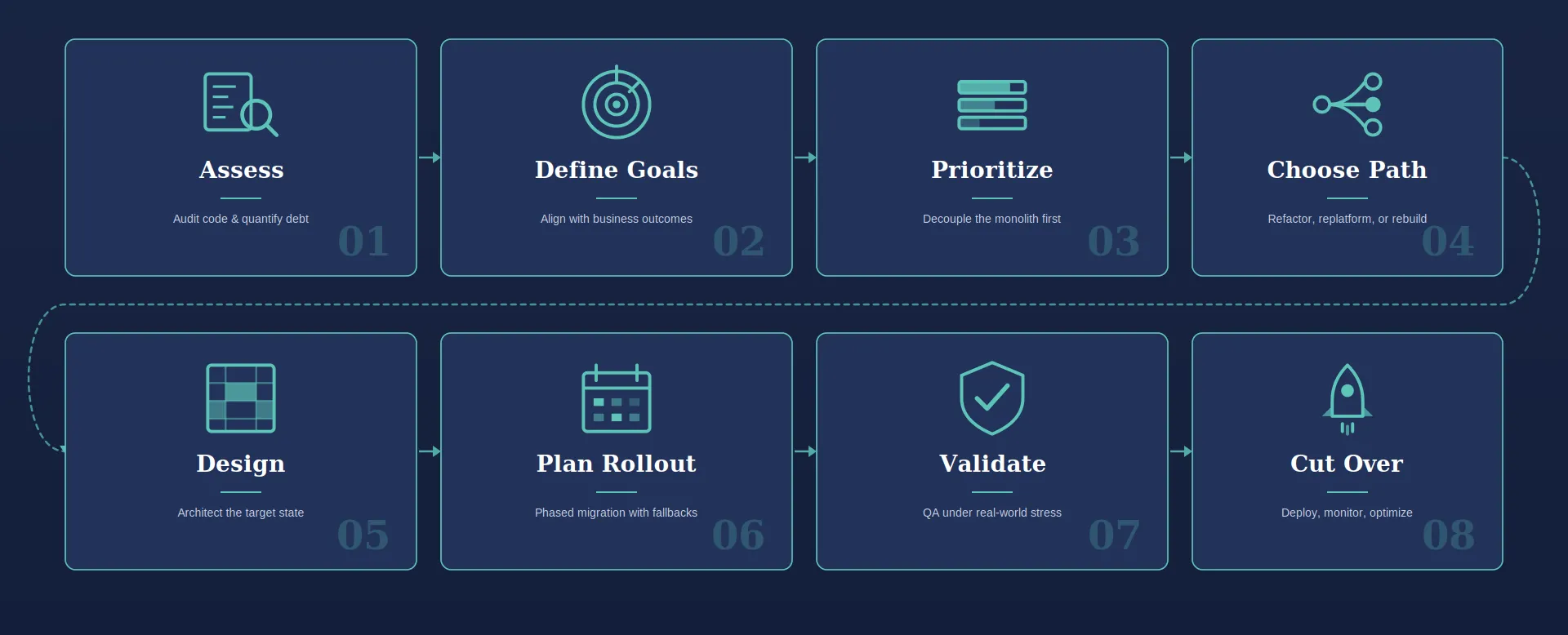
- Step 1. Assess the current state: Engineers audit the codebase, map hardware dependencies, and identify the exact scope of the technical debt.
- Step 2. Define business goals: Stakeholders align the technical upgrade with clear business outcomes, such as faster deployment times or lower hardware costs.
- Step 3. Prioritize systems or modules: The team identifies which parts of the monolith to decouple first, usually starting with low-risk, high-reward components.
- Step 4. Choose the approach: Based on the assessment, the engineering team commits to a specific strategy, such as refactoring or rebuilding.
- Step 5. Design the target state: Architects design the new cloud infrastructure, database schemas, and microservice boundaries.
- Step 6. Plan migration and rollout: The team creates a phased deployment schedule, including data migration scripts and fallback recovery protocols.
- Step 7. Test and validate: Engineers run heavy automated, manual, security, and load testing to ensure the new architecture performs under real-world stress.
- Step 8. Cut over, monitor, and optimize: The modernized module is pushed live. The team monitors system logs for latency or errors before proceeding to the next module.
By adhering to this structured framework, companies avoid the massive risks associated with “big bang” deployments. This phased process ensures that your business continues to operate smoothly while the architecture beneath it is systematically replaced.
Legacy Modernization Benefits
Upgrading outdated infrastructure is an investment that yields concrete financial and operational returns. The legacy modernization benefits go far beyond simply having newer code; they directly impact how aggressively your company can compete in the market.
- Reduced operational costs: Retiring obsolete physical hardware and optimizing cloud server usage dramatically reduces your monthly infrastructure bills and software licensing fees.
- Accelerated time-to-market: Moving to a decoupled microservices architecture allows your engineering teams to develop, test, and release new features in days rather than months.
- Enterprise-grade security: Modern architectures natively support advanced encryption, multi-factor authentication, and automated compliance tracking, protecting you from data breaches.
- Data mobilization: Breaking down legacy data silos allows you to connect your operational data to modern business intelligence and analytics tools for real-time decision-making.
When executed correctly, legacy app modernization shifts your IT budget from simply keeping the lights on to actively driving business growth and operational efficiency.
Legacy Modernization Examples
Different sectors face unique constraints when dealing with technical debt. Modernization looks entirely different depending on the regulatory environment and the specific physical operations of the business.
Banking and Financial Services
A regional bank relies on an aging mainframe for core transaction processing. Because the system cannot handle concurrent API requests, the bank cannot launch a modern mobile app. Engineers apply mainframe legacy modernization to wrap the core system in secure microservices, allowing the bank to release a mobile application without risking the integrity of the underlying transaction ledger.
Healthcare
A hospital network uses a fragmented legacy Electronic Health Record (EHR) system that forces nurses to enter patient data multiple times. The modernization team rearchitects the database and integrates unified APIs. This allows patient data to sync instantly across different hospital wings, ensuring compliance with HIPAA while significantly speeding up emergency room triage.
Manufacturing
An automotive parts manufacturer tracks inventory using an outdated on-premise ERP system that crashes during peak production hours. The engineering team replatforms the database to a highly available cloud environment and refactors the inventory module, ensuring factory managers have real-time visibility into parts availability without system latency.
Government
A state DMV relies on an obsolete, monolithic desktop application built thirty years ago to process license renewals. The modernization team executes a complete rebuild, extracting the complex legal rules from the old code and creating a modern, secure, citizen-facing web portal that automates renewals and reduces lines at physical offices.
Oil and Gas
A global energy company relies on localized, disconnected servers to monitor pipeline pressure sensors. Engineers execute a cloud for legacy modernization strategy, migrating the sensor data pipelines into a centralized AWS architecture. This allows headquarters to monitor global pipeline health in real-time, predicting maintenance needs before hardware fails.
These examples highlight how different approaches—from API wrapping to complete rebuilds—are deployed to solve highly specific industry bottlenecks.
Legacy Modernization Challenges
Upgrading a live system without disrupting daily revenue requires precision. Legacy modernization challenges routinely derail projects if technical leaders fail to account for the hidden complexities within their aging software.
| Challenge | Why it happens | How to reduce the risk |
|---|---|---|
| Complexity and risk | Old monolithic systems are tightly coupled; changing one feature often breaks unrelated functions. | Use dependency mapping tools and insist on phased, module-by-module rollouts. |
| Cost and time | Discovery phases uncover hidden technical debt, extending the timeline and burning through budgets. | Conduct a thorough, multi-week technical audit before committing to a fixed budget or deployment date. |
| Resistance to change | Internal staff are comfortable with the old interface and refuse to adopt the new workflows. | Involve end-users early in the design phase and provide extensive, hands-on training prior to launch. |
| Data migration and integration | Legacy databases often have corrupted, duplicated, or non-standardized historical data. | Write and test careful data cleansing scripts in sandbox environments before attempting the final cut-over. |
| Skills and expertise | Internal IT teams rarely possess both the legacy language knowledge and modern cloud architecture skills. | Partner with a specialized software modernization agency to bridge the technical talent gap. |
| Legacy system interdependencies | The application relies on undocumented connections to external third-party tools that no one remembers building. | Deploy automated discovery tools to map every single API call and network request currently hitting the server. |
| Regulatory and compliance requirements | Moving highly regulated data (like financial or health records) to the cloud triggers strict security audits. | Embed compliance officers into the engineering team from day one to ensure architecture meets regulatory standards natively. |
By acknowledging these hurdles during the planning phase, engineering teams can build the necessary risk mitigation protocols directly into the project roadmap.
Legacy Modernization Tools
You cannot unravel a million lines of undocumented code manually. Professional engineers use specific legacy modernization tools to automate discovery, test code integrity, and manage cloud deployments safely.
| Tool / Category | How it helps | When to use | Complexity | Setup speed | Typical output |
|---|---|---|---|---|---|
| Discovery / inventory tools | Maps the network to find hidden servers and databases. | Step 1 (Assessment) to understand the full infrastructure scope. | Low | Fast | Network topology maps. |
| Code analysis tools | Scans legacy code for dead functions, security flaws, and coupling. | During the strategy selection phase to gauge technical debt. | Medium | Medium | Code quality and dependency reports. |
| API / integration tools | Creates secure bridges between old monoliths and new cloud services. | When refactoring or wrapping legacy code to enable modern access. | High | Slow | REST/GraphQL API endpoints. |
| Cloud / container platforms | Packages old apps into isolated environments (like Docker) to run anywhere. | When rehosting or replatforming to AWS/Azure. | High | Medium | Containerized application images. |
| CI/CD & test automation | Automates code deployment and regression testing to prevent breaking changes. | Required for all modernization paths to ensure safe rollouts. | High | Slow | Automated deployment pipelines. |
| Observability tools | Monitors server health, database query speeds, and error logs in real-time. | During and after the cut-over phase to catch immediate failures. | Medium | Fast | Real-time performance dashboards. |
| Data migration tools | Automates the extraction, transformation, and loading (ETL) of historical data. | When moving off legacy databases (like DB2) to modern cloud storage. | High | Slow | Cleansed, synchronized databases. |
| Security / compliance tools | Scans the new architecture for vulnerabilities and compliance violations. | Continuous use throughout the development and testing phases. | Medium | Fast | Automated vulnerability audits. |
| AI-assisted tools | Uses LLMs to explain undocumented legacy code (like COBOL) to modern developers. | When dealing with massive, legacy codebases lacking documentation. | Medium/High | Varies by security requirements. | Plain-English code documentation. |
These tools remove the guesswork from the engineering process, ensuring that the modernization is driven by hard data rather than developer assumptions.
Best Practices for Legacy System Modernization and Deliverables
Executing a successful modernization relies heavily on solid project management. Legacy modernization techniques only succeed when the engineering team adheres to proven best practices and produces clear, tangible deliverables at every stage of the process.
To ensure transparency and alignment, a modernization project must generate specific deliverables before moving to the next phase:
- A detailed technical audit and dependency map.
- A formalized target architecture design document.
- A detailed data migration and cleansing strategy.
- Automated testing scripts and quality assurance logs.
- Clear API documentation for the newly modernized modules.
Securing these deliverables requires adherence to industry best practices:
- Avoid ‘big bang’ releases where possible: Always break the project into small, manageable modules.
- Test in parallel: Run the legacy system and the new modernized system simultaneously to compare data accuracy before shutting down the old server.
- Automate everything: Rely on CI/CD pipelines and automated testing to catch regressions instantly.
- Prioritize the data: Code can be rewritten, but lost historical data will cripple the business. Focus heavily on data mapping and ETL (Extract, Transform, Load) testing.
By focusing on these deliverables and best practices, technical leaders maintain control over the budget, timeline, and risk profile of the system overhaul. If your modernization project requires outside engineering support, it is worth reviewing how to choose a software development company before committing to a long-term technical partner.
How Codemasters Helps with Legacy Modernization
Codemasters International treats modernization as a highly structured engineering discipline. We understand that your business cannot pause operations while we rewrite your software. Our engineers combine deep architectural expertise with clear risk mitigation strategies to safely transition your aging infrastructure.
- Fixed-Cost Assessments: We conduct detailed technical audits of your codebase to provide clear roadmaps, protecting you from open-ended hourly billing.
- Phased Rollouts: We decouple your monoliths module by module, deploying production-ready features quickly without disrupting your daily workflows.
- Cloud-Native Architecture: We migrate your constrained on-premise databases to scalable, highly available cloud environments.
- Security First: We embed enterprise-grade encryption and compliance frameworks directly into your new system architecture.
Stop letting technical debt dictate your business growth. Partner with Codemasters to turn your legacy bottlenecks into scalable, modern assets.
Conclusion
Legacy modernization is the strategic process of updating, refactoring, or rebuilding outdated software systems to eliminate technical debt and unlock business agility. It is not merely an IT infrastructure upgrade; it is a critical business initiative that reduces maintenance costs, hardens cybersecurity, and allows your company to integrate with modern digital tools. By replacing rigid codebases with scalable architectures, businesses ensure their technology is a piece of infrastructure that actually does its job, instead of something your team fights with every day.
FAQ
What are the first steps in a legacy modernization project?
The first step is conducting a detailed technical audit. Engineers must map your current infrastructure dependencies, analyze the depth of your code’s technical debt, and align these findings with your specific business goals before selecting a modernization strategy.
How long does it typically take to modernize a legacy system?
Timelines depend heavily on system size and the chosen strategy. A basic cloud rehosting takes a few weeks, while rebuilding complex enterprise architectures takes months. We use phased rollouts to ensure you receive functional, live modules quickly, rather than waiting a year.
What is the difference between legacy modernization and digital transformation?
Legacy modernization focuses strictly on upgrading existing technical infrastructure, code, and databases to improve efficiency and security. Digital transformation is a broader, company-wide initiative that changes fundamental business models, organizational workflows, and how you deliver value to customers.
What are the biggest legacy modernization challenges?
The primary challenges include unraveling undocumented, tightly coupled code without breaking core functions, migrating corrupted historical data safely, and managing the high upfront costs. Additionally, bridging the skills gap between legacy programming languages and modern cloud architecture is a persistent hurdle.
What is legacy application modernization?
Legacy application modernization is the specific process of updating a single, outdated software program. This involves refactoring its code, updating its language, or moving it to a cloud environment to improve performance, security, and its ability to integrate with modern APIs.